Wednesday, July 28, 2010

2011 Kia Sportage Review Pictures and Wallpapers

The new Kia Sportage marks a dramatic shift in design direction for Kia's compact SUV. Longer, lower and wider than the previous generation model, the new Kia Sportage is immediately identifiable by its 'tiger' face - incorporating Peter Schreyer's striking signature grille design that links all new Kia models.

"The new Sportage is fresh and bold and could not be mistaken for anything other than a Kia," said Peter Schreyer, Kia's Chief Design Officer. "It embodies Kia's new-found visual dynamism by successfully taking the key features of an off-road vehicle - the raised ground clearance, the commanding driving position and heightened sense of security - and enveloping them in a sleek and urban-friendly design with global appeal. With its athletic and muscular design the Kia Sportage fits its name perfectly."

Sitting below the central bonnet-mounted badge, the 'tiger face' sweeps out to effectively frame the grille before broadening out and encompassing the car's large and piercing headlamps to create a distinctive and powerful face. The strength of this look is reinforced by the clamshell bonnet and its contours that run into raised shoulders as they flow down to meet the headlamps.

Kia is confident that when current Kia Sportage owners and new customers to the brand visit dealer showrooms to view the all-new Kia Sportage, they will be mightily impressed by the newcomer. Its showroom 'presence' will be both impactful and surprising.

New Kia Sportage will be available in a stunning new metallic colour - Techno Orange - and first impressions will also be enhanced by the new bright chrome finish for the front grille- the strong Kia 'face' - as well as the bold reverse-angle C-pillar, the wider track, purposeful stance and much closer relationship between the wheels, tyres and wheel-arch - creating a premium appearance and echoing the precision and care that has been applied to the entire vehicle.

Inside new Kia Sportage, the styling echoes the new kind of dynamic aesthetics created by the exterior appearance and establishes a new kind of ambience, with top-quality fit, discreet trim accents and the availability of numerous high-tech features. New Sportage will be built with a choice of two equipment levels, LX and EX (for details see Section 8), plus a wide range of options.

The longer bodyshell and longer wheelbase, plus the extra interior width ensure that occupants of the new Kia Sportage will enjoy its spacious cabin. The adoption of a reverse-angle for the C-pillar moves it 186 mm further back - compared with the previous model - placing it behind the rear seat passengers to provide them with a clear view out. Entry and exit from the cabin is made easier by lowering the seats by 29 mm and the top of the door sills by 31 mm.

Driver comfort is enhanced by the adoption of a floor-hinged accelerator pedal that allows smooth control of the throttle and by the increased range of fore and aft sliding movement available for the driver's seat - 24 mm more than the previous model. As an option, heated front and rear seats can be specified.

2011 Kia Sportage Front
2011 Kia Sportage Side view
2011 Kia Sportage Front view
2011 Kia Sportage
2011 Kia Sportage Pictures
2011 Kia Sportage on the Road
2011 Kia Sportage Interior
2011 Kia Sportage Seats
Manufactured at Kia's world-class facility in Slovakia, the all-new Kia Sportage will ultimately be available in Europe with a wide choice of engines. At launch this summer, the engine line-up will comprise 2-litre diesel and 2-litre petrol engines - with a 1.7-litre diesel and a 1.6-litre GDI petrol unit to follow later this year, reducing the new model's base-line CO2 emissions to less than 140 g/km.
2011 Kia Sportage Interior

Tuesday, July 27, 2010

Cadillac Escalade 2010 Review with Images

The Cadillac Escalade is a full-size luxury sport utility vehicle (SUV) sold by the General Motors luxury brand, Cadillac. It was the division's first major entry into the popular SUV market. The Escalade was introduced for the 1999 model year in response to German and Japanese competitors and to Ford's 1998 release of the Lincoln Navigator. The Escalade project went into production only ten months after it was approved. The Escalade is built in Arlington, Texas. The name Escalade refers to a siege warfare tactic of scaling defensive walls or ramparts with the aid of ladders or siege towers. The Escalade was originally based on the GMC Yukon Denali, but was redesigned for the 2002 model year to make its appearance fall more in line with Cadillac's new design theme. Today, the Escalade and Escalade EXT pickup are two of only three Cadillac vehicles made outside of the United States. Both the Escalade ESV (Based on the Chevrolet Suburban) and Escalade EXT (based on the Avalanche sport utility truck) were made in Silao, Mexico before the 2006 redesign; the new Escalade ESV is sourced from Arlington, Texas. The Escalade competes with the Range Rover Sport, Infiniti QX56, Mercedes-Benz GL-Class, Lexus LX, Toyota Land Cruiser, Land Rover LR3 and Lincoln Navigator.Cadillac Escalade 2010 Front view
Cadillac Escalade 2010 Back view
Cadillac Escalade 2010 side view
Cadillac Escalade 2010
Cadillac Escalade 2010 Inside view
Cadillac Escalade 2010 Interior
Cadillac Escalade 2010 Engine
Cadillac Escalade 2010 Interior

Lexus LFA Complete Overview and Specifications

The Lexus LFA is a two-seat exotic sports coupe produced by Lexus as a concept car, "halo" vehicle, racing prototype, and production model. It is the second model in the F marque line of performance vehicles from Lexus, following the IS F. Three concept versions have been shown, each debuting at the North American International Auto Show with the LF-A designation as part of the LF Series concept line. The first LF-A concept premiered in 2005, followed in 2007 by a second LF-A with a more completely furnished interior and exterior. The third version of the LF-A, a roadster model, premiered in 2008. The production model, trademarked LFA, was shown at the Tokyo Motor Show in October 2009. The production Lexus LFA features a new V10 engine and a carbon fiber-reinforced polymer (CFRP) body. CFRP materials account for 65 percent of the LFA's body composition by mass. The LFA is scheduled to go into production in late 2010, with a projected run of 500 vehicles at the base price of US$375,000.A circuit-tuned variant is scheduled for 2012.The production Lexus LFA has an overall length of 177.4 inches (4,510 mm), while its wheelbase measures 102.6 inches (2,610 mm), with a height of 48 inches (1,200 mm) and width of 74.6 in (1,895 mm). Compared to the prior 2007–2008 concepts, the production model is nearly 2 inches (51 mm) longer, with identical width, height, and nearly same wheelbase dimensions. The exterior design of the LF-A concepts and the final production model was the work of car stylists led by Lexus Design general manager Kengo Matsumoto. The overall design ethos was based on the principle of form follows function, with aesthetics secondary to aerodynamics and operation.

The LFA body features sharp edges and cutoffs for improved aerodynamic performance, made possible by the carbon fiber body. body was designed with an emphasis on downforce. There are air scoops located over the rear fenders which feed the aft-mounted radiators and help cool the brakes. A horizontal hood gap also feeds air to the engine. Two small aft vents expel air that is collected by an underbody air scoop and used to cool the titanium exhaust pipes. Dual hood ducts serve to move hot air away from the exhaust manifold.

The LFA's speed-sensitive rear wing incorporates a Gurney flap and deploys at speeds over 50 mph. With the wing retracted the LFA's body has a drag coefficient of Cd 0.31. The LFA body is offered with a choice of 28 standard exterior colors, along with 3 wheel colors and a matte black option. Additional "special colors" are available to order. The front and rear fenders, doors, roof rails, and rocker panels are made out of blast fiber reinforced sheet panels, while the tail lamps are light-emitting diode (LED) lights.

Lexus LFA
Lexus LFA Side view
Lexus LFA 2010
Lexus LFA Front view
The LFA interior incorporates carbon fiber, leather, alcantara, and metallic surfaces. There are two bucket seats, and Lexus' Remote Touch controller interface. The interior design uses bespoke materials and colors.The instrument display is a digital thin-film transistor (TFT) speedometer with color-changing background, size-changing numbers, and side-appearing submenus
In operation the TFT display shows small digits in automatic mode; larger and bolder numbers in normal mode; inverted colors, moved redline, and stark numbers in sport mode, along with a programmable redline warning color change. The tachometer display also features an electric movable metal ring with layer acrylic plastic to create a 3D effect. The LFA further features a new driver and passenger seat-belt airbag design increases similar to the S-Class ESF safety concept car. The steering wheel features a right-mounted start button and alloy paddle-shifters. To activate the vehicle the driver must insert the key beside the steering wheel then press the start button. Two octaves of engine sound are channeled into the cabin via twin ducts which connect the firewall with intake manifold, with the sound tuned in the manner of an Ovation guitar. A 12-speaker Mark Levinson sound system with compact lightweight components was also developed for the interior.The Lexus LFA is powered by a 72° 4.8-liter V10 engine equipped with dual VVT-i carrying the 1LR-GUE designation with a maximum output of 560 PS (412 kW) delivered at 8,700 rpm. Its maximum torque output of 354 lb·ft (480 N·m) arrives at 6,800 rpm, 90 percent of which is available from 3,700 rpm. The engine redlines at 9,000 rpm, but with a fuel cutoff set at 9,500 rpm, and is constructed using forged aluminum pistons, forged titanium connecting rods, and solid titanium valves. Dry sump lubrication prevents engine oil starvation through high speed corners and lowers the engine's center of mass. Air is fed directly from beneath the hood through a visible slit passing into a dual stage variable intake manifold and then into ten individual throttle bodies before finally exiting from a dual stage titanium muffler.
The LFA's engineers selected a V10 engine over an equivalent displacement V8 engine for its higher revs, and over a V12 for its lower reciprocating mass,allowing for more rapid engine response. Lexus claims their engine can rev from idle to its redline in 0.6 seconds and an analog tachometer needle could not accurately track the LFA's changes in engine speeds. This necessitated the use of digital tachometer which can instantly display engine speed. The engine reportedly weighs less than the manufacturer's own 3.5-liter 2GR-FE V6 engine. Engineers attempted to make the engine sound like that of a Formula One car with high revs, while at the same time maintaining reliability and vibration control. Along with other manufacturers such as Ferrari, Toyota had produced their own F1 engines and chassis designs. The exhaust note was meant to sound like the "roar of an angel", and a US television spot later used the engine sound to shatter a champagne glass via resonance frequency
Lexus LFA Inside view

Infiniti G35 Coupe Complete Review with Pictures

The Infiniti G is a mid-size/entry-level luxury car produced by Nissan's luxury brand Infiniti. The first two generations of the Infiniti G (P10 and P11) were compact executive sedans based on the Nissan Primera. Beginning with its third generation (V35), it has since shifted to mid-size, the Infiniti G have been rebadged versions of the Nissan Skyline line of sedans and coupes that were exported to the United States and Canada. The current incarnation is the fourth generation (V36) which introduced 2-door convertibles. The Nissan FM platform, on top of which the 3rd and 4th generations (V35 and V36) of the Infiniti G have been built, has shared components with the Infiniti M and also underpins the 350Z and the Infiniti FX models.
It was a concept vehicle that became the basis of V36-based G coupe. It included a full-length glass panel roof, modulated front fenders and hood, deep front spoiler and large projector headlights, polished bare metal-look paint, compact camera outside rearview mirrors, hidden door handles and large 20-inch, 9-spoke painted aluminum-alloy wheels.
Infiniti G35 Coupe Front view
Infiniti G35 Coupe Wallpaper
Infiniti G35 Coupe Front
Infiniti G35 Coupe Seats
Infiniti G35 Coupe Rims
Infiniti G35 Coupe Interior
The G20 was powered by the SR20DE Inline 4-cylinder. It was a transversely mounted dual overhead cam naturally aspirated reciprocating internal combustion engine. Displacement was 2.0 litre (1998 cc) with a square (Bore × Stroke: 86.0 × 86.0 mm). This engine was also shared with the US-spec Nissan Sentra/Nissan 200SX SE-R, Nissan NX2000, and a host of non-US Nissan vehicles. The particular version used in the G20 produced 140 hp (100 kW) crank in the US at first, and 145 hp (108 kW) in '00+ editions (116 to 126 whp; stock range) and 132 lb·ft (179 N·m) or 136 lb·ft (184 N·m) torque (111 to 120 wft·lbf; stock range). These engines were also fairly high-revving with a redline of 7500 rpm for 1991 through 1996 editions, 6950 rpm for the 1999 edition, and 6750 rpm for 2000+ editions. Due to the SR20DE engine's flexibility, reliability, fuel economy and high power-handling capabilities, as well as a low buy-in cost, pre-owned NX2000, SE-R powered Sentras/200SXs and G20s have become popular and prominent in the "tuner" or "import scene" subculture.

There were three major variants of the SR20DE used in the G20. The first, used from 1991 to 1993.5, was the highport, in which the injectors and fuel rail were located above the intake plenum. In 1994, due to tightening emissions restrictions, Nissan switched to a lowport design, in which the injectors and fuel rail switched places with the intake plenum. This design also featured a milder intake camshaft. (Switching it out for the highport intake cam is a popular upgrade to gain more power.) This design was used from 1994 to 1996 and again in 1999. In 2000 Nissan replaced the valvetrain with a roller-rocker arm lifter design in place of the (non roller) rocker arm previously used, but kept the lowport intake design; many performance parts are not interchangeable between roller-rocker and highport/lowport engines, most notably camshafts.

Infiniti G35 Coupe Inside view

Monday, July 26, 2010

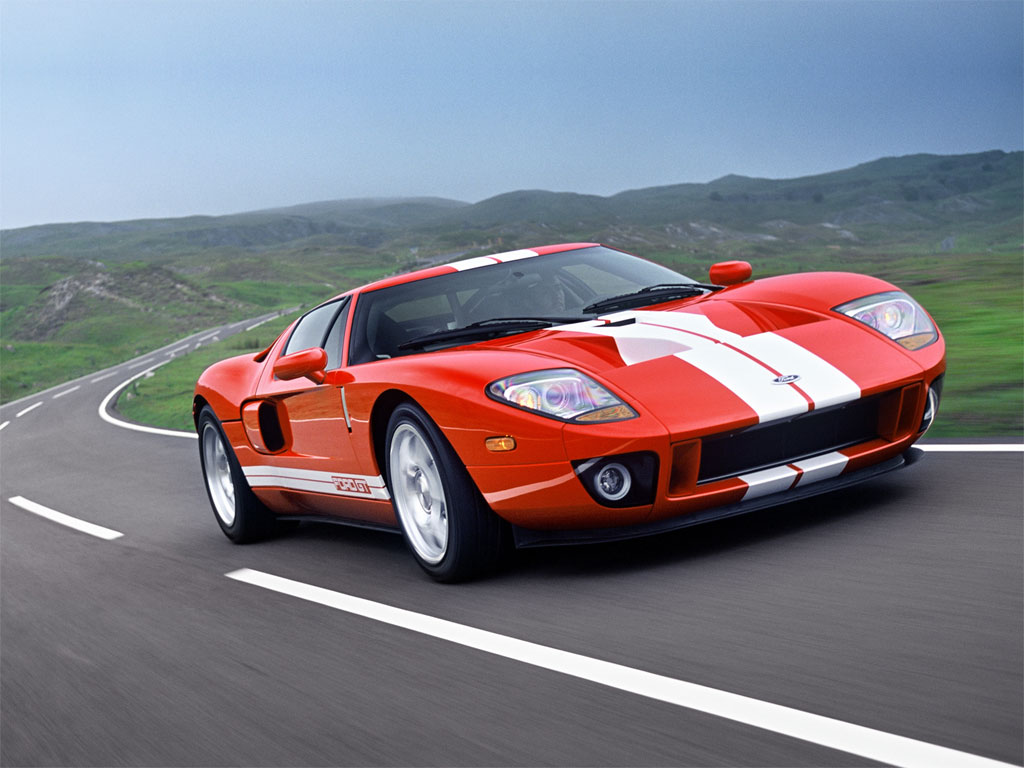
Ford GT Review with Complete Specificaton

The Ford GT is a mid-engine two-seater supercar. Ford Motor Company produced the Ford GT for the 2005 to 2006 model years. The designers drew inspiration from Ford's classic GT40 race cars of the 1960s, and the new Ford GT is sometimes mistaken for its 1960s counterpart.
The Ford GT features many new and unique technologies, including superplastic-formed aluminum body panels, roll-bonded floor panels, a friction-stir welded center tunnel, a "ship-in-a-bottle" gas tank, a capless fuel filler system, one-piece door panels, and an aluminum engine cover with a one-piece carbon-fiber inner panel.

Brakes are four-piston aluminum Brembo calipers with cross-drilled and vented rotors at all four corners. When the rear canopy is opened, the rear suspension components and engine are visible.

The mid-mounted 5.4 L Modular V8 engine is all-aluminum with a Lysholm twin screw-type supercharger. It features a forged rotating assembly housed in an aluminum block designed specifically for the GT program. A dry sump oiling system is employed, allowing the engine to sit low in the car's frame. The DOHC 4-valve heads are a revision of the 2000 Ford Mustang SVT Cobra R cylinder heads (with slightly increased wall casting thickness in the exhaust port). The camshafts have unique specifications, with more lift and duration than those found in the Shelby GT500 or 2003–2004 Ford Mustang SVT Cobra. Power output is 550 hp (410 kW) and 500 ft·lbf (680 N·m) of torque. A Ricardo six-speed manual transmission is fitted featuring a helical limited-slip differential.
1...0–60 mph (0–96 km/h): 3.3 seconds, 3.6 seconds, 3.7 seconds
2...0–100 mph (0–160 km/h): 7.4 seconds
3...0-150 mph (0–241 km/h): 16.9 seconds
4...Standing 1/4 mile (402 m): 11.2 seconds @ 131.2 mph (211.1 km/h), 11.6 seconds @
5...126.2 mph (203.1 km/h), 11.78 seconds @ 124.31 mph (200.06 km/h)
6...Top speed: 205 mph (330 km/h) (electronically limited)The United States Environmental Protection Agency mileage estimate for the GT is 12 mpg-US (20 L/100 km; 14 mpg-imp) in city driving, and 19 mpg-US (12 L/100 km; 23 mpg-imp) in highway cruising, for a combined 14 mpg-US (17 L/100 km; 17 mpg-imp
Ford GT Wallpaper
Ford GT Interior
Ford GT Engine
Ford GT Inside view
Related Posts Plugin for WordPress, Blogger...